
Empowering Fund-Wide Transformation Through Modern Operations

A Midwest real estate investment manager with over $10 billion in AUM maintained a vertically integrated fund operations model. Their in-house team owned every step from capital activity to LP reporting, which gave them strong control and operated as a real differentiator in fundraising. The cost: an operational stack built on Yardi IM and a layered set of Excel workbooks that grew more fragile with each new fund and side letter.
- The "Excel ceiling" hits when waterfall verification, formula errors, and key-person dependencies start growing faster than the fund. Scaling AUM by adding headcount works only until LP reporting demands outpace what added staff can absorb.
- Maintaining vertical integration is non-negotiable for funds that built their internal operations as a competitive advantage. Modernization needs to enhance that, not replace it.
- Waterfall calculations and investor allocations dropping to 70% less prep time isn't a rounding error. That's days of senior finance time per quarter redirected from data wrangling to scenario analysis.
- Eliminating key-person dependencies is structural, not optional. When the one person who hand-built a fund's fee model leaves, the firm's risk profile changes overnight. Systematized calculations remove that single point of failure.
- Adding the next $2B AUM without growing the finance team is the test fund infrastructure must pass. Firms still operating in spreadsheets hit the headcount wall before the AUM wall.
Hitting the "Excel Ceiling"
Quarter-close required the controller team to reconcile capital account balances calculated in Excel against Yardi IM outputs. Discrepancies surfaced every cycle. The fee model that handled side-letter overrides for the firm's institutional LPs was held together by one senior associate's formula structure. When she went on parental leave, the team rebuilt the model from scratch over four weeks.
Investor reporting demands compounded. Pension funds and sovereign wealth LPs asked for sector-level performance breakdowns, vintage-blended returns across their commitments, and quarterly fee transparency disclosures that Yardi IM could not produce natively. The finance team built each report manually, which meant a $2B follow-on fundraise was competing for staff time with the quarterly close.
Scaling the firm meant either doubling the finance team (proportional headcount growth they had explicitly rejected) or rebuilding the operational stack.
Automation Without Losing Control
The CFO's mandate to the finance team was specific. Replace the Excel layer entirely. Keep Yardi IM as the property-level general ledger, because the asset management team's workflows depended on it. Build a parallel fund-level computation system that could handle the firm's specific waterfall structures, side-letter overrides, and scenario modeling needs without forcing manual reconciliation against the GL.
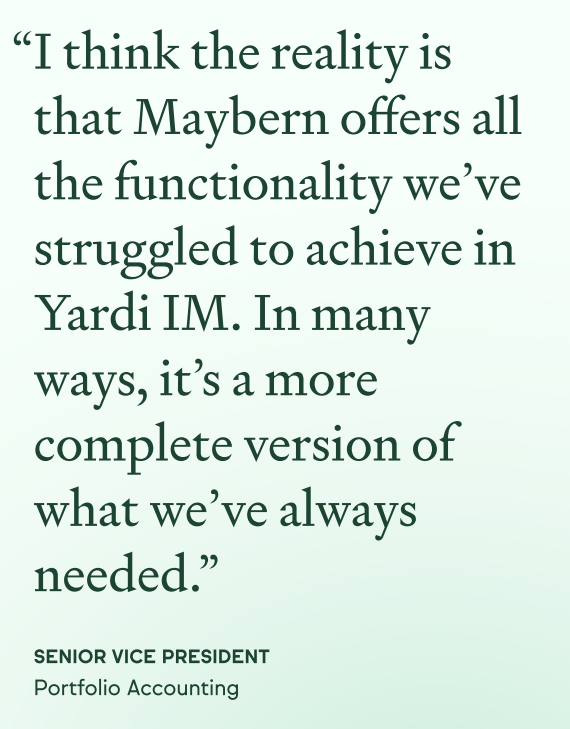
The team evaluated three categories of tools: fund admin platforms that would have required outsourcing the operational layer the firm had built as a moat; standalone waterfall engines that solved one calculation problem but left the LP-level allocation work in Excel; and integrated fund management platforms that could replace the Excel layer wholesale while connecting to the existing GL. Maybern fit the third category.
Implementation and Results
Implementation ran in parallel with quarterly close. Maybern's Solutions Architects encoded the firm's three fund vintages, their hybrid waterfall structures, and the side-letter terms that had previously lived in a private OneNote. Historical data from the prior eight quarterly closes was loaded and reconciled against the existing Yardi records.
The first measurable change was time. Waterfall and investor allocation prep, which had taken nine to eleven working days per fund per quarter, dropped to two to three. The team redirected the recovered time to scenario analysis, fee strategy review, and LP communication.
The second change was the kind of question the finance team could answer.
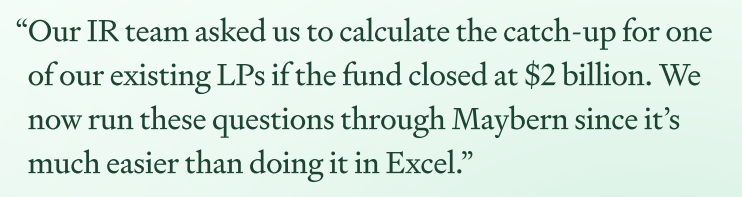
The catch-up calculation that previously required a senior controller to build a one-off Excel model over a day and a half now runs as a query, with the result traceable to the underlying capital activity and the LP's specific side-letter terms.
The third change was structural. The fee model that had depended on the senior associate's formula structure is now a configurable rule set inside Maybern, with logic documented at the level of the LP's contractual terms rather than at the level of Excel cell references. The key-person dependency is gone.
Audit trails for every calculation are automated. The fund's auditor receives traceable lineage rather than a stack of workpapers. The firm's first full close on the new system completed two days ahead of schedule.
Conclusion
The firm is now underwriting fund four with operational headroom they did not have before. Two structural decisions previously deferred (a parallel sidecar vehicle for a strategic LP segment, and a co-investment program with vintage-blended fee economics) are back on the table because the operational cost of running them is no longer prohibitive.
The bet on vertical integration was a contrarian one in an industry trending toward fund admin outsourcing. The firm is doubling down on it.
Frequently asked questions
Quick reference for this topic.
01How does a vertically integrated real estate manager modernize without losing the operational moat?
The firm in this story chose to replace the Excel layer entirely while keeping Yardi IM as the property-level general ledger. The operating principle was straightforward: outsource what is commoditized, keep in-house what is differentiated. Fund administration is increasingly commoditized. The fund-level computation that handles waterfalls, allocations, and LP-specific terms is the moat, and that stayed in-house, just on better infrastructure.
02What does it actually cost to maintain vertical integration in fund operations?
For a $10B RE manager with three vintage funds and roughly 50 institutional LPs, the in-house operational stack required two senior controllers plus a fee model maintained by a third. Before modernization, those three roles spent the majority of their time on reconciliation and report production. After, those same three roles handle materially more work because Excel reconciliation has been removed from the workflow entirely.
03When does the cost of an Excel-based fund operations stack outweigh the benefit of vertical integration?
The signal is usually a fundraising cycle the firm cannot support without doubling finance headcount. For this manager, the trigger was the IR team's increasing volume of LP-specific scenario requests during a $2B follow-on fundraise. The Excel stack could service the fund. It could not also service the questions an institutional LP was going to ask before allocating.
04What is the catch-up calculation, and why is it operationally hard?
The catch-up is the contractual provision that allocates carried interest to the GP after LPs receive their preferred return, until the GP reaches their full carry share. The math is straightforward but path-dependent: side-letter terms, individual LP commitments, and fund-close timing all change the answer. In Excel, recalculating the catch-up for one LP at a specific fund-close scenario is a half-day project. In a configurable rule system, it is a query.
05Is shadow accounting still necessary when fund operations are modernized?
For this firm, no. Shadow accounting exists because GP teams do not trust the fund administrator's outputs and run parallel records to catch errors. When the GP team operates as the source of truth and Yardi IM serves as the property-level GL, there is no third-party administrator to shadow. The reconciliation work shifts from finding the admin's errors to confirming the property-level GL matches the fund-level allocation logic, which is structural verification, not error-finding.
Recommended Content


AI Sovereignty Is the Future of Fund Alpha

The Maybern MCP is Live
